
Helping Manufacturers Meet Environmental Regulations
A Regenerative Thermal Oxidizer (RTO) from Ship & Shore Environmental is custom engineered to treat industrial VOC emissions and support the air pollution abatement requirements of your facility. Our RTO systems and industrial thermal oxidizers lead the emission abatement technology market by using state-of-the-art engineering to repurpose the thermal energy created during operation, resulting in lower costs and less energy consumption. Our expert team of engineers can help your company improve Regenerative Thermal Oxidizer Efficiency, performance and energy use while addressing application-specific air quality requirements.
Custom Engineered VOC Abatement Systems
As a leading Regenerative Thermal Oxidizer Manufacturer, we know that no two problems are alike, and therefore no single Regenerative Thermal Oxidizer Specification can be created to meet all of our client’s needs. We provide our clients with the right equipment to meet their specific needs. The TCEQ, EPA, BAAQMD, SCAQMD, and other regulatory authorities on air quality require companies to collect and destroy VOC emissions from their manufacturing operations in order to reduce the impact on the environment. Our philosophy is to develop energy efficient and innovative products to assist our customers in meeting the increased environmental demands passed on by these regulatory agencies, while also enhancing productivity and profitability.
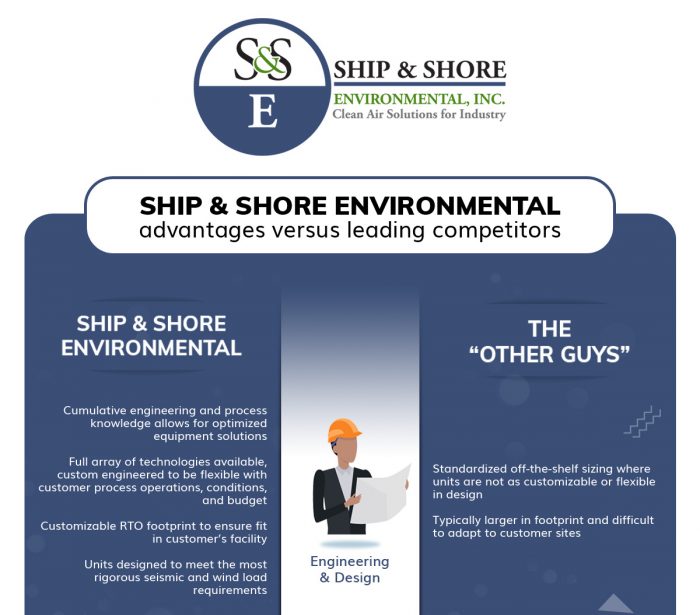
Our equipment is specifically designed & sized to meet the particular process conditions of your facility. At Ship and Shore Environmental, our company is not limited to just one technology for VOC abatement. We offer both RTO Verification Services as well as RTO Testing Services. In fact, our other services include a broad set of offerings and products to our customers including (CAD) computer assisted drafting, customized fabrication, and management of custom projects. Working with our customers closely, we serve as a true engineering partner and Regenerative Thermal Oxidizer Supplier.
During the development of our RTO (Regenerative Thermal Oxidizers) systems, our goal is to offer the highest-quality and most reliable VOC Thermal Oxidizer abatement systems for each specific application. Our team is capable of providing complete support from the initial concept all the way through installation and into the commissioning. Our support staff speaks multiple languages to support customers from all around the globe.
For each unique Regenerative Thermal Oxidizer Design project, we utilize our experience and expertise to create the best overall system at the most efficient Regenerative Thermal Oxidizer Cost. Our factory trained technicians are available by phone 24/7 to help with service, troubleshooting and maintenance for VOC abatement systems.
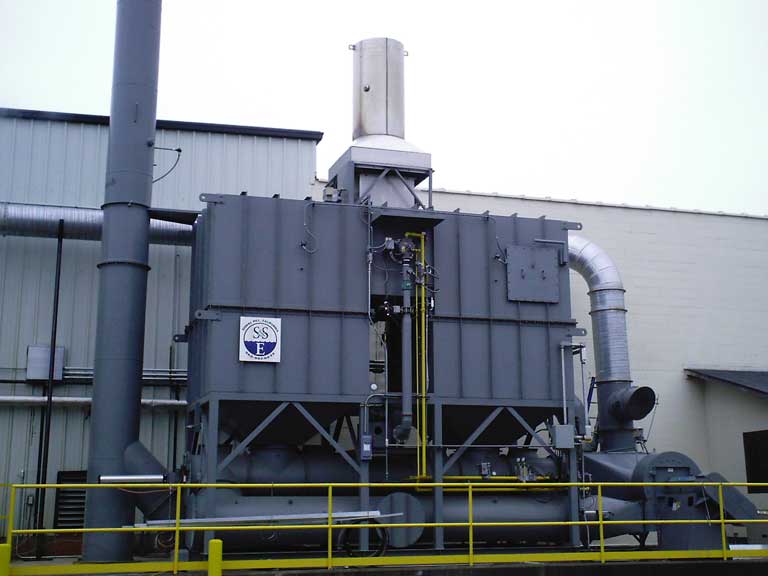
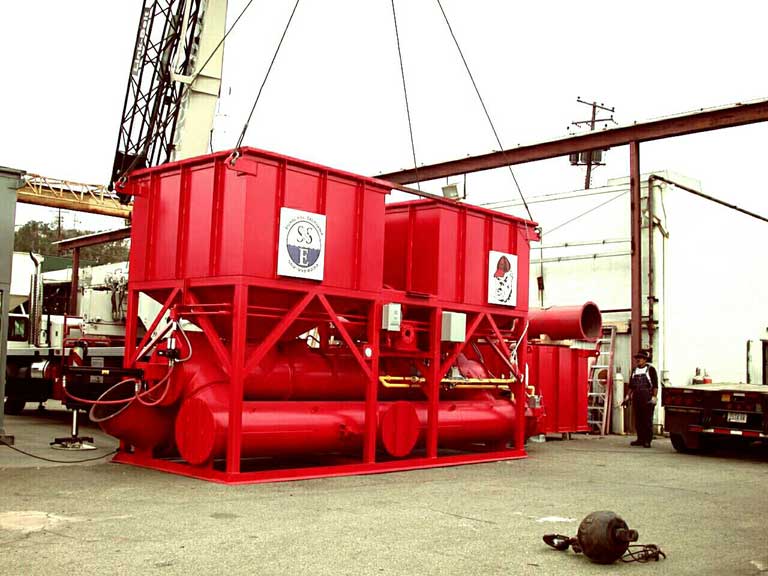
View Ship & Shore Environmental RTO Installations:
Our Engineering Processes
At Ship and Shore Environmental, we provide customized engineering solutions and industrial thermal oxidizers for air-pollution abatement. We engineer, design and fabricate environmental products and systems. A majority of our clients are required to collect and destroy emissions generated by their manufacturing operations.
When you work with Ship and Shore, we become your strategic partner from initial permit application to commissioning, with the system designed around applicable air pollution requirements.
The Regenerative Thermal Oxidizer (RTO)
Ship & Shore’s systems convert volatile organic compounds into carbon dioxide and water by using a system called a VOC Thermal Oxidizer. Commonly, VOC’s are emitted by manufacturing facilities as part of their processes. These VOC’s are typically referred to as solvent fumes, hazardous air pollutants, hydrocarbons, halogenated hydrocarbons and other odorous emissions.
Typical Process Applications include, but are not limited to:
- Variable process flow rates and VOC concentrations, with lower explosive limit (LEL) considerations reviewed for the specific application.
- VOC destruction rates ranging from 96-99%
- Differing solvent mixtures and/or exhaust air volumes running together on same production line.
RTO Performance and Capabilities
The published performance ranges below describe application-dependent capabilities, not a guarantee for every exhaust stream. Final destruction efficiency, heat recovery and operating conditions are established during project engineering and verified through the applicable testing requirements.
- Published heat-recovery capability of 95%-97%, depending on the system and operating conditions.
- Published VOC destruction capability of 96%-99%, depending on the application and verified performance requirements.
- Low NOx Burners
- The ability to work with chemicals in a solvent mixture providing catalyst destruction properties.
- Having multiple burners available: propane, natural gas, Low BTU gas, LPG or fuel oil burners.
- Supplemental fuel demand depends on VOC heat content, airflow, heat recovery and operating conditions.
Engineering and Management of Environmental Projects
Ship & Shore is an international company serving clients throughout the Americas, Europe and Asia. Our team of experts provides overall engineering and management of environmental projects to reduce greenhouse gas emissions, always aiming to keep utility operating costs down through enhanced energy efficiency and waste heat recovery solutions like VOC thermal oxidizers.
Ship & Shore is also instrumental in recovering incentive rebates sponsored through utility providers for new and improved equipment operation.
Our skilled teams are available twenty-four hours a day, seven days a week. Discuss your project with Sales or Service at 562-997-0233, or request an RTO project review.
Specify an RTO around your process
Regenerative thermal oxidizer selection starts with the exhaust stream, not a standard equipment size. Ship & Shore evaluates VOC collection, thermal oxidation, energy recovery and plant integration together.
| Project consideration | What to evaluate |
|---|---|
| Airflow and production | Normal and peak exhaust flow, operating hours, process variability and future expansion. Identify whether flow data is reported as SCFM or ACFM. |
| Exhaust composition | VOC species and concentration, temperature, moisture and particulate loading. Process-specific hazards and materials compatibility require engineering review. |
| Performance requirements | Applicable permit limits, collection requirements, destruction efficiency, monitoring and performance testing. |
| Footprint and installation | Available equipment space, access for maintenance, ductwork routing, foundations, stack placement and utility connections. Final dimensions are established for the selected configuration. |
| Lifetime operating cost | Fuel and electricity rates, fan power, pressure drop, heat recovery, maintenance and planned production changes, alongside the initial equipment price. |
For terminology, explore the airflow and SCFM guide, RTO energy consumption and RTO performance testing.
Compare system options and project scope
Review electric RTO systems and gas-electric hybrid RTO systems alongside conventional gas-fired configurations. Utility availability, energy prices, process conditions and permit requirements determine the appropriate approach; no operating mode is the lowest-cost choice for every facility.
A project may also include secondary heat recovery, process exhaust collection, system design, fabrication, installation and commissioning. The proposal should identify exactly what is included and where the facility or other contractors have responsibility.
Already operating an oxidizer? Discuss aftermarket inspection and support or ceramic media replacement and upgrades before deciding whether a new system is necessary. Use our RTO repair vs. replacement guide to compare condition, capacity, downtime, and lifecycle cost.
RTO engineering in real applications
These published Ship & Shore case studies show how application requirements shape the design. Results are project-specific and are not performance or savings guarantees for another facility.
Printing & packaging
Expansion-ready VOC collection
A flexographic packaging project combined a custom RTO with collection-system design, variable airflow and regenerative heat recovery. The project qualified for more than $350,000 in utility incentives.
Metal recycling
31,000 SCFM process capacity
A Colton, California project incorporated ceramic heat recovery and a hot bypass system for changing VOC concentrations. The published design describes 98% destruction efficiency and greater than 95% thermal effectiveness.
Food-waste processing
Odor control with room to grow
An expandable RTO was designed for capacity up to 50,000 SCFM. The published case study reports annual energy savings exceeding $560,000 through improved thermal efficiency and reduced fuel consumption.
Start with a project review
Share your facility location, manufacturing process, project timeline and the challenge you need to solve. Include available airflow, emissions and utility information, but do not delay an initial conversation because some data is missing.
Our team can discuss the information needed to evaluate system fit and prepare an appropriate proposal. For urgent support on existing equipment, use the 24/7 aftermarket service contacts.